
With a bit of ingenuity and dexterity, it is possible to count well beyond ten using one's fingers. The Venerable Bede, finding Greek mathematical notation cumbersome for computing the calendar, describes just such a method in De Temporum Ratione in the eighth century. The same method is described by Robert Recorde in The Grounde of Artes in the sixteenth century, though the role of the hands have been swapped. We can assume, then, that the method was in use throughout the SCA period, though Recorde notes that it was not well known despite its antiquity.
This method is not the same as the "Chisanbop" method of Pai and Pai (1981) , which seems to be a much more recent development, though the principles of the two systems are similar.
Recorde has an excellent diagram of what all the hand positions look like, reproduced here as Figure 1, so I'll use his convention rather than Bede's. The basic idea is to divide your fingers into two groups on each hand, and each group will represent one digit of a four-digit number in Arabic notation. The third, fourth and fifth fingers of the left hand represent the ones position, while the thumb and forefinger of the same hand represent the tens position. The third, fourth and fifth fingers on the right hand represent the hundreds, and the thumb and forefinger the thousands.
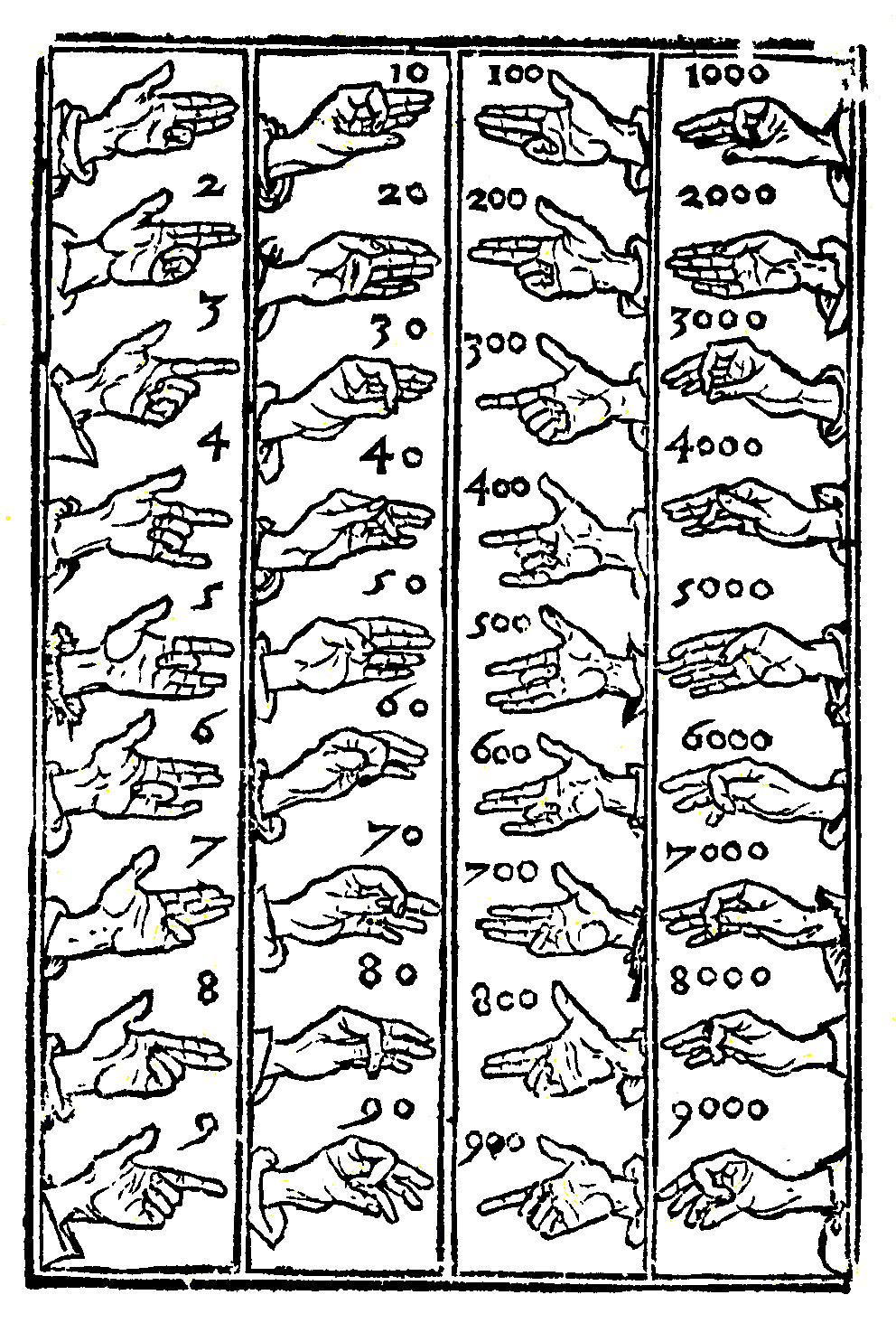
Figure 1. The Arte of Numbryng by the Hand, from Recorde.
The ones are signified by the last three fingers of the left hand:
The tens are then signified by the thumb and forefinger:
The same positions on the right hand denote one hundred times as those on the left hand. The gymnastics required to make of all these positions may take some practice, but at the end of the day it doesn't matter if you can't quite make them all cleanly, so long as you can distinguish nine different positions for each group of fingers.
Recorde stops here, but Bede goes on to larger numbers, made by placing the hand on the body:
The same positions using the right hand denote numbers ten times as large. The position for twenty thousand, and Bede's manner of expression, seems to imply that you aren't making any numerals with your fingers at the same time. It should be possible to do so (possibly using a different sign for twenty thousand), however, allowing you to express any six-digit number on your human abacus. Bede also has a symbol for one million, being both hands clasped together.
The reader might have noticed that there is no sign for zero. The zero symbol in Arabic notation is just a placeholder and there is no need for it where the digits are constrained to be in certain positions, as on an abacus or in the finger system. If you want to think of zero as having an explicit sign, it is the sign with all the fingers extended.
The only copy of De Temporum Ratione that I have been able to find is the English translation of Chapter II given by Yeldham (1926). This excerpt does not include any instructions on how to do computation though Yeldham implies that they exist. Recorde ends The Grounde of Artes promising to continue finger-reckoning after he had covered fractions, but he never seems to have gotten around to doing so; his later book, The Whetstone of Witte, covers only Arabic notation.
Nonetheless, we can see how computation can be (and probably was) done by considering the algorithms used by an abacus. Compared to the abacus I described in an earlier article (se leof, 2002), the finger-abacus has a disadvantage in that it can only represent one number at a time. However, bead-frame abaci, such as those used in ancient Rome and the modern Far East, are similarly limited and is still possible to compute interesting things with them; a detailed description of the algorithms can be found in Moon's book (1971).
Think of using a simple four-function calculator or adding machine. If you ignore the memory function, these devices have only one register, called the accumulator, which stores a single number. The only thing you can do is add, subtract, multiply or divide this number with a second number typed in on the keyboard, with the result replacing the contents of the accumulator. Using the gestures I described in the previous section, it is possible to use your hands as an accumulator that works in the same way.
Addition and subtraction can be done on the fingers using the essentially the same algorithm as for Arabic notation on paper. Multiplication can be done using the abacus algorithm that I described in the earlier article; at each step you add (or, "accumulate") a partial product onto your hands. Division is a little harder but can be done using the algorithm given in Moon's book.
For very complex computations, it may be necessary to employ a "memory" by writing down partial results on a piece of paper for later reference — or call them out to a friend who will, since your hands are otherwise occupied.
Bede suggests that the hand-signals for numbering can be used as a primitive kind of sign language by associating the sign for one with the letter 'A', the sign for two with 'B', and so on. As well as being used as a training exercise or an amusement, he also suggests that this code could be used to communicate secretly with friends amongst enemies. Of course this would do you no good if your enemies also knew finger-reckoning (or your friend cannot read, a more likely problem for Bede's contemporaries). The application to deaf people seems to have escaped him.
Undoubtedly, breaking into a series of wild gesticulations whenever one wanted to compute a sum would look rather bizarre and comical to the untrained eye. Then again, so does wearing garb, so what are you worried about?
P. Moon. The Abacus, 1971.
H. Y. Pai. The Complete Book of Chisanbop, 1981.
R. Recorde. The Grounde of Artes, 1542.
R. Recorde. The Whetstone of Witte, 1557.
Æ. se leof. Arithmetic by Counters, Cockatrice 16, 2002.
F. A. Yeldham. The Story of Reckoning in the Middle Ages, 1926.
Originally published in Cockatrice #17, January 2003.